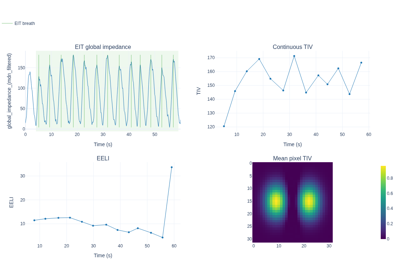
m3resp.IntervalData#
- class m3resp.IntervalData(name, modality, intervals, values=None, category=None, unit=None, method=None, metadata=<factory>)[source]#
One value for each interval, in the same order as the intervals.
- Variables:
name (str) – What the values are, e.g.
'tidal_impedance_variation'.modality (str) – The device the values were measured with. This can differ from the device the intervals were found in: EIT values can be computed over breaths found in ventilator data.
intervals (list[m3resp.data.events.Interval]) – The intervals the values belong to. A
BreathEventis anInterval, so a list of breaths works here too.values (collections.abc.Sequence[Any] | numpy.ndarray | None) – One value per interval, in the same order: a list, a tuple, or an array whose first axis runs over the intervals. A value can be a number, an array (for example a pixel map) or an m3resp object such as a
ParameterResult.Nonewhen only the intervals themselves are the result.category (str | None) – The physical quantity the values are derived from (see
m3resp.data.categories).unit (str | None) – Unit of the values, normalized to a recognized spelling.
method (str | None) – Name of the method that produced the values.
- Raises:
TypeError – If an item of
intervalsis not anInterval, or suppliedvaluesare other than a list, tuple or array with at least one dimension.ValueError – If supplied
valueshave a different number of entries thanintervals.
- Parameters:
Attributes